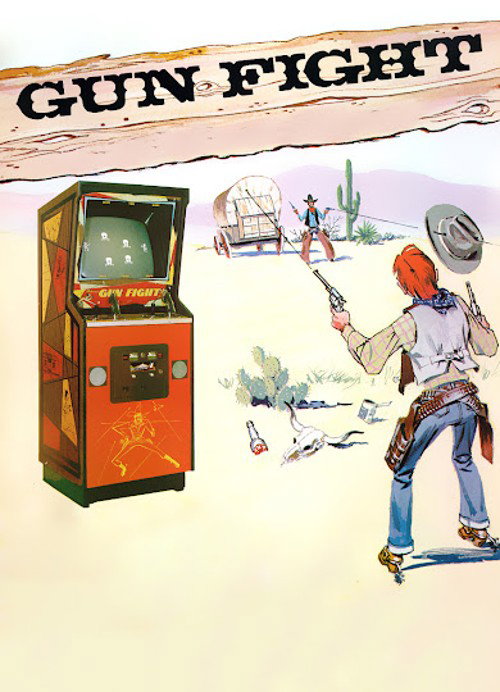


Gun Fight is a two-player arcade video game released by Midway Manufacturing in 1975. It was Midway’s licensed adaptation of Taito’s Japanese game Western Gun, which Taito had issued earlier that year. The premise is deliberately spare: two cowboys stand on opposite sides of a single-screen frontier arena and try to shoot one another. A successful hit ends the round; the player who wins enough rounds takes the match.
The game is notable not for a narrative campaign, but for its competitive design and technical history. Each contestant uses a joystick and a firing control. The system lets players move their cowboy while aiming the gun separately, producing duels in which position and firing direction matter at the same time. Bullets travel across the screen and can be stopped by scenery, so the central wagon and cactus formations are tactical cover rather than decoration. Players can also shoot around the edges of the playfield: a bullet leaving one side reappears from the other, creating a route around obstacles.
Taito’s Western Gun was designed by Tomohiro Nishikado, who later created Space Invaders. For the North American Gun Fight conversion, Midway worked with Dave Nutting Associates. The original Taito hardware used discrete logic, whereas Midway’s version used an Intel 8080 microprocessor. This made Gun Fight the first arcade video game to use a microprocessor, a distinction repeatedly associated with the Midway release. The 8080-based hardware also supported a different implementation from Taito’s original, including a more detailed visual presentation.
Gun Fight belongs to the formative period of commercial coin-operated video games. Its two-player confrontation follows the earlier arcade success of Pong, yet replaces abstract paddles with animated gunfighters and a Western setting. The cabinet presents the action from above, with the duelists facing each other across terrain. Instead of a solo progression, its appeal rests on direct, repeatable contests between people sharing the cabinet. That format made every round immediately legible: movement creates an opening, terrain blocks a shot, and a bullet can return from the opposite side. Gun Fight therefore remains important both as a playable early duel and as a landmark in the transition of arcade machines from discrete-logic circuitry to microprocessor control. Released during 1975, it did not depend on a named hero, scripted ending, or continuing world. Its historical identity comes from the specific combination of Taito’s concept and Midway’s pioneering Intel-based hardware for North American arcade players then.
Reazioni
0
0 Commenti
Diventa il primo a commentare
Niente qui ancora.
Imparentato Gioco
Gioco
EA Sports FC 25
Gioco
Helldivers 2
Gioco
Zenless Zone Zero
Gioco
Until Dawn 2
Gioco
Final Fantasy 7 Rebirth
Gioco
Final Fantasy Tactics: The War of the Lions
Vuoi ricevere notifiche su nuovi articoli e spoiler?