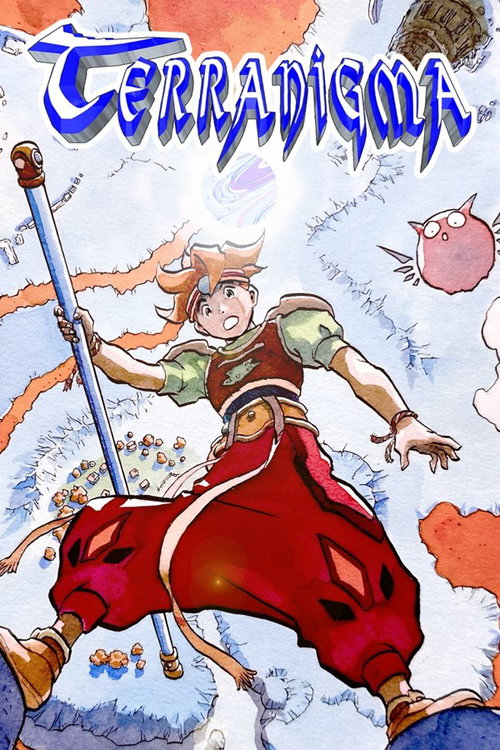


Terranigma is an action role-playing game developed by Quintet and published by Enix for the Super Famicom. It was released in Japan on December 22, 1995, and later in Europe in 1996; North America never received a release from Enix.
Story begins in Crysta, where teenager Ark lives under the elder's care. After opening a forbidden door, he finds a box and freezes the villagers, starting a quest connected to the world's creation, humanity, and future on the surface world.
The box contains Yomi, who explains that Crysta exists in an underground world. To restore the sealed village, Ark must reach the surface where Earth has been left lifeless after conflict between two cosmic powers, Light Gaia and Dark Gaia.
Ark's journey revives the continents one by one. He raises the surface's plants, birds, and animals, then helps civilization return. This structure makes world restoration a mechanic: progress is represented not only by battles, but also by environments becoming inhabited.
The game follows two perspectives on humanity. Ark encounters settlements, including Louran, where a tragic event leaves the town haunted, and Loire, whose development reflects the player's economic choices. Later, characters Meilin and Elle connect Ark's adventure to its themes.
Quintet designed Terranigma as the concluding entry in its Soul Blazer trilogy, following Soul Blazer and Illusion of Gaia. The games share ideas about restoration, souls, and world renewal, but Terranigma uses its setting and characters instead of continuing those stories.
Its combat is real-time rather than turn-based. Ark can slash, thrust, dash, jump, and combine movement with attacks, while special techniques consume magic points. Dungeons contain puzzles and bosses, and the adventure's progression depends on opening routes through a overworld.
Terranigma treats development as part of its fantasy. Ark's travels move from revived nature toward villages, trade, technology, and modern cities. The game turns a creation story into its history of human civilization over time while retaining a coming-of-age narrative.
The soundtrack was composed by Miyoko Kobayashi and Masanori Hikichi, and the game's presentation uses pixel art to give regions an identity. Its tone shifts between wonder, melancholy, humor, and tragedy, as Ark learns that restoration carries consequences for worlds.
Although it appeared late in the Super Famicom's life, Terranigma became one of Quintet's discussed works. Its limited release history has strengthened its reputation, but the game's importance rests on its blend of action combat, planetary restoration, imagination, and storytelling.
ردود الفعل
0
0 تعليقات
كن أول من يعلق
لا شيء هنا بعد.
متعلق ب لعبة
لعبة
Super Mario Bros.: The Lost Levels
لعبة
Super Mario Bros. 3
لعبة
Dead by Daylight
لعبة
Factorio
لعبة
Factorio: Space Age
لعبة
The Witcher
هل تريد تلقي إشعارات بالمقالات الجديدة ومعاينات البطاقات؟